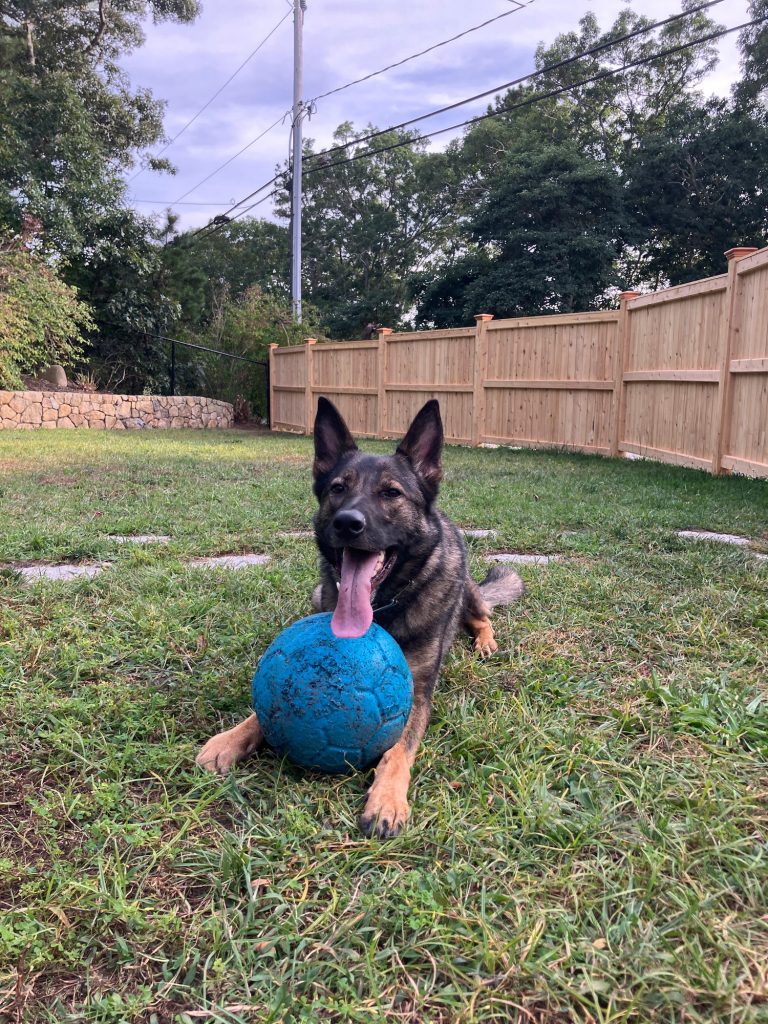
Meadow, one of our German Shepherds, is 4 years old. She lives with idiopathic epilepsy and takes medication every day. This page is a plain-language introduction to the condition: what it is, what a seizure can look like, how daily treatment usually works, and why a calm routine and a secure, familiar yard matter so much to her.
What idiopathic epilepsy is
Idiopathic epilepsy is a neurological condition marked by repeated seizures when no underlying cause (such as a brain tumor, an injury, or a metabolic problem) can be found. It is a diagnosis of exclusion: veterinarians reach it after other explanations have been ruled out.
It is also the most common cause of seizures in dogs. Seizures typically begin between six months and six years of age. Cornell University’s College of Veterinary Medicine notes a median age of onset of 2.5 years. A genetic component is known in some breeds and suspected in others. German Shepherd Dogs are among the breeds with a recognized predisposition.
Once treatment starts, many dogs need lifelong management with anti-seizure medication and regular monitoring. The aim is fewer, shorter, or milder seizures and a good quality of life, not a promise that every seizure will stop.
What a seizure looks like
A seizure is a burst of abnormal electrical activity in the brain. In dogs it often has three phases:
- Pre-ictal: some dogs show subtle changes first, such as restlessness or anxiety. Others give little or no warning.
- Ictal: the seizure itself, often lasting seconds to a couple of minutes.
- Post-ictal: a recovery period of confusion, disorientation or lethargy as the brain resets. Some dogs may seem anxious, temporarily blind, or unusually hungry.
Generalized (tonic-clonic) seizures are the ones many people picture: a dog may fall, stiffen, paddle or jerk, drool, vocalize, lose bladder or bowel control, and lose awareness of its surroundings. VCA Animal Hospitals notes that a typical generalized seizure lasts one to two minutes.
Focal seizures are more localized. They can look like repeated twitching of a lip, eyelid or ear, a “fly-biting” snap at the air, or a chewing-gum motion of the jaw. The dog may or may not lose consciousness. A focal seizure can sometimes spread into a generalized one.
Daily medication
When medication is recommended, veterinarians commonly prescribe anticonvulsants such as phenobarbital, potassium bromide, levetiracetam and zonisamide. Some dogs do well on one drug; others need a combination. The choice, the dose and any changes belong with the dog’s veterinarian. We don’t discuss Meadow’s specific medication or dose here.
Dosing has to be consistent, on time and every day. Blood levels of these drugs need to stay in a helpful range, and skipping doses can make seizures more likely. VCA’s guidance on phenobarbital, a frequently used option, is direct: the medication must be given regularly, doses should not be skipped, and it should not be stopped suddenly. It has to be tapered under veterinary direction. Regular bloodwork is part of care, both to check drug levels and to watch for side effects.
Keeping a simple seizure log (when it happened, how long it lasted, and how the dog seemed before and after) helps a veterinarian adjust treatment. A short video of an event can also be useful.
Triggers, routine and a secure space
Not every seizure has a clear trigger, and many occur without one. Still, owners of dogs with idiopathic epilepsy often notice patterns. In a 2018 study in the Journal of Veterinary Internal Medicine, owners of 37 of 50 dogs (74%) reported at least one seizure-precipitating factor. The most frequently reported factors included stress-related situations, sleep deprivation, weather and hormonal changes. Among the situations owners marked were a change in daily routine, unfamiliar places, visitors at home and, in some cases, a missed dose of medication.
That is why a steady routine, lower stress, safe exercise and a familiar, enclosed space matter so much. A fenced yard lets a dog run and play close to home, without the startle and unpredictability of a busy road or an unfamiliar place, and it gives a family a secure area if a seizure happens outdoors. For Meadow, the fence is part of that everyday safety: a known place to move her body, keep her schedule, and be close by if she needs us.
What to do during a seizure
Watching a seizure is frightening. The most helpful things are usually simple:
- Stay as calm as you can, and keep the dog from being injured. Move breakable objects or hazards away. If the dog is near stairs, protect it from a fall if you can do so safely.
- Do not put your hands, or anything else, in the dog’s mouth. Dogs do not swallow their tongues during a seizure, and you are likely to be bitten.
- Avoid crowding, hugging or restraining the dog. During a seizure, and sometimes in the confused minutes afterward, a dog may not recognize you and can snap without meaning to.
- Time the seizure. If you can, take a video for your veterinarian.
- Once it has stopped, keep the surroundings quiet and let the dog recover. Stay close, but give it space if it seems disoriented or agitated.
If your veterinarian has prescribed an emergency medication to use at home during a seizure, follow those instructions exactly.
When it’s an emergency
Most single, short seizures are not, by themselves, immediately life-threatening. Two situations are medical emergencies and need veterinary care right away:
- A seizure that lasts more than five minutes, often called status epilepticus. This can lead to dangerously high body temperature and, if it continues, brain injury or death. Take the dog to an emergency veterinarian immediately.
- Cluster seizures: more than one seizure in a 24-hour period. Clusters can also be dangerous and can progress to status epilepticus. Seek emergency care.
If you are ever unsure, call your veterinarian or the nearest emergency clinic and describe what you are seeing.
Meadow’s daily routine
Meadow’s days are built around consistency. She takes her medication as prescribed, every day, and she sees her veterinarian for the monitoring her treatment requires. She still needs what any working-line German Shepherd needs: regular exercise, play, and a job to do, in a place where we can keep her safe. The fenced yard gives her that space close to home, in surroundings she already knows. We don’t share her specific drug, dose or seizure history here; those details stay between our family and her vet.
If you’d like to meet her (and Venom, who shares the yard with her), start with Meet Meadow & Venom. Why We Built It explains why this particular yard is the one practical, secure place we have for them.
Sources
The information on this page is drawn from the veterinary sources below. We linked to each one and checked that the pages were reachable when this was written. We have not added statistics or claims that those sources do not state.
- Idiopathic epilepsy in dogs (Cornell University College of Veterinary Medicine, Richard P. Riney Canine Health Center)
- Managing seizures (Cornell University College of Veterinary Medicine, Richard P. Riney Canine Health Center)
- Seizures in Dogs (VCA Animal Hospitals)
- Epilepsy in Dogs (VCA Animal Hospitals)
- Phenobarbital (VCA Animal Hospitals)
- Monitoring Epileptic Patients (VCA Animal Hospitals)
- 2015 ACVIM Small Animal Consensus Statement on Seizure Management in Dogs (Journal of Veterinary Internal Medicine)
- Seizure-precipitating factors in dogs with idiopathic epilepsy (Journal of Veterinary Internal Medicine, 2018)
- Epilepsy Research (AKC Canine Health Foundation)
A note about this page
This page is for general education. It is not veterinary advice, a diagnosis, or a treatment plan for any dog. If your dog has had a seizure, or you have questions about medication, dosing or emergencies, please consult your veterinarian. If a seizure lasts more than five minutes or seizures are clustering, seek emergency veterinary care right away.